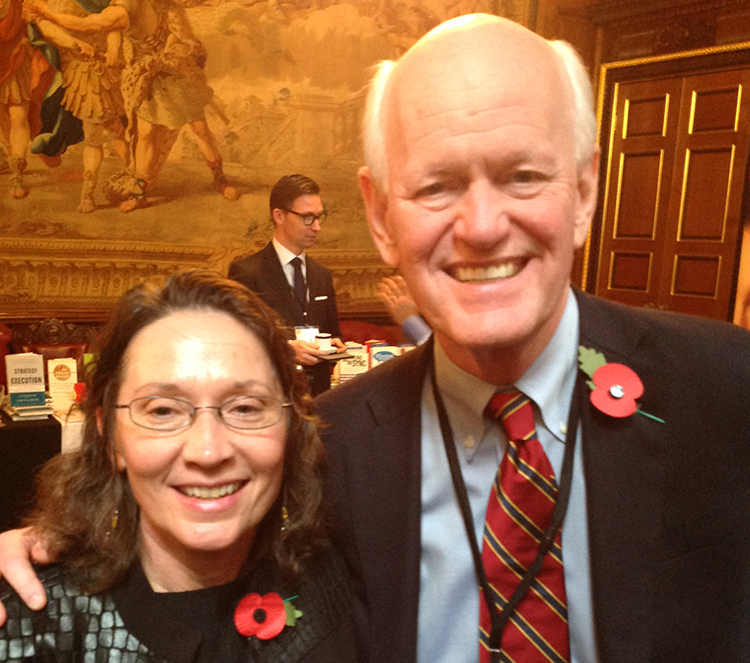
Marilyn McLeod, personal management coach for small business owners, takes the reader through seven important steps to increase success in business, projects, and life. Idea-generator, reference, and comfort food for the soul, the book has a friendly tone and includes candid stories of real people and key principles by today’s greatest thinkers. Easy to read with chapter summaries and exercises, 7 Steps to Success in Business & in Life: During Recession or Recovery is a powerful tool for people in any capacity who choose to take an active role in creating a better life for themselves and those around them.
Seven Steps to Success in Business & In Life: During Recession or Recovery is a valuable guidebook for all of us on our journey to success, however we define it.
The questions the book asks are almost more valuable than the answers provided. And the exercises help move us into the future that we will redefine, in our own way, after taking Seven Steps… to heart. - Frances Hesselbein
Frances Hesselbein is the Chairman of the Board of Governors of the Leader to Leader Institute, was the Founding President of the Peter F. Drucker Foundation and was CEO of the Girl Scouts of the USA, 1976-1990. Mrs. Hesselbein was awarded the Presidential Medal of Freedom, the United States of America's highest civilian honor, in 1998 by President Clinton. In 2002 Mrs. Hesselbein was the first recipient of the Dwight D. Eisenhower National Security Series Award for her service "to national security and the nation."
She is the author of Hesselbein on Leadership, published in August of 2002. Be, Know, Do: Leadership the Army Way, introduced by General Eric K. Shinseki and Frances Hesselbein was published in February of 2004. She is the co-editor of more than 20 books in 28 languages including Hesselbein on Leadership, Leader of the Future 2 and Organization of the Future 2, and is Editor-In-chief of Leader to Leader journal.
Psychotherapist and philosopher Nathaniel Branden, Ph.D. is a lecturer, practicing psychotherapist, and author of twenty books on the psychology of self-esteem, romantic love, and the life and thought of Objectivist philosopher Ayn Rand. His work has been translated into 18 languages and has sold over 4 million copies, and includes such titles as Taking Responsibility, The Six Pillars of Self Esteem, and My Years with Ayn Rand.
The name Nathaniel Branden has become synonymous with the psychology of self-esteem, a field he began pioneering over thirty years ago. In that time, he has done more than any other theorist to advocate the importance of self-esteem to human well-being, a mission which began with his involvement in Objectivist philosopher Ayn Rand's "Inner Circle."
As an entrepreneur running a small consultancy business, Marilyn's coaching has inspired me to carry on when things looked tough, and given me ideas for new ventures based on what's in my toolkit, interpreted with her help in whole new ways. Her assistance has been profoundly important to my overall success over the past few years.
Marilyn's book does something unique: It brings together some of the most valuable inspirational resources but also practical "nuts and bolts" knowledge that we all need. Her book is helping me in both ways to get through these very difficult times and reach my goals. I credit this book in helping me to thrive not just survive. - Gary Ranker
Dr. Gary Ranker is considered by Forbes magazine and other media as one of the top five executive coaches. Gary specializes in corporate politics. For more information visit www.GaryRanker.com or have a look at the new book just released by John Wiley & Sons "Political Dilemmas At Work".
For all the small business owners out there who are struggling in these times, Marilyn McLeod has written a primer you MUST read. It contains heartfelt and hard-won wisdom for all who want to get beyond the mass of information and infomercials they receive every day. This book literally is brimming with enthusiasm while offering clear ideas for success.
In this book Marilyn offers practical steps for anyone who wants to start or grow their own business. She does so in a way that is principled as well as reflective. While she channels wisdom from Marshall Goldsmith to Nathaniel Brandon, her real contribution is to the business owner. Her 7 principles resonate with the concept that YOU are the most important engine of growth for your own enterprise, and she offers guidance for how you should best spend your precious time, as well as how to think beyond the present in overcoming challenges and obstacles. She offers some great stories to support her points, while keeping the perspective of a coach who is there to help you. - James Goodrich
James Goodrich, Founding Dean
Marshall Goldsmith School of Management
Alliant International University www.Alliant.edu
I know Marilyn and well enough that I can actually hear her voice in the book. And it is a refreshingly encouraging voice – never down, always warm and capable of making you see things that you knew but were unable to relate to your own circumstances till she showed you how. She is self effacing but does not mince words and shows you very clearly what you have to do to junk the detritus you carry around with you – often without realizing it! – and start living a life where great things happen to you routinely, and where every day is a blast. This will not happen to you if you merely read the book. There is an excellent chance that it will happen to you if you actually do the things she so clearly and lovingly prescribes. - Srikumar S. Rao
Professor Srikumar Rao, author of Are You Ready to Succeed? and The Personal Mastery Program. His "Creativity and Personal Mastery" course has been so successful at London Business School, Columbia Business School, and Haas School of Business that it has its own alumni association.
Especially valuable during a time of global economic uncertainty that affects all leaders and businesses - small and large - the 7 Steps provides invaluable insights across a set of timely topics. Marilyn's coaching expertise provides guidance in a manner that focuses on you, the reader. She has uniquely assembled wisdoms from great leadership thinkers in a simple to understand and actionable set of stories and exercises. A must read for today's times. - David G. Thomson
David G. Thomson, author of Blueprint to a Billion: 7 Essentials to Achieve Exponential Growth
Martin Luther King Jr once said, “The ultimate measure of a man is not where he stands in moments of comfort and convenience, but where he stands at times of challenge and controversy.” In Seven Steps to Success in Business & In Life: During Recession or Recovery, Marilyn courageously shares with us her past personal challenges, and like Phoenix rising from the ashes, provides a road map you can immediately use to be successful in your personal and business life. Marilyn serves as your personal coach by first helping you define the person within you, therefore making it easier to create the world you so desire around you. A must read! - James Singletary
James Singletary, All-American, former NFL Linebacker, now a Behavioral Optometrist and OrthoKeratologist specializing in adult & pediatric eye care, behavioral/neuro-optometry at the vision therapy center he shares with his partner and wife, Dr. Eva Shiau, at EyeMedics in Fayetteville, North Carolina.
I have known and worked with Marilyn for almost 10 years. She has always surrounded herself and learned from an eclectic group of the best thought leaders. In her very timely book she shares her personal journey and the journey of others to knowledge and towards wisdom in a very usable way. All we need is the courage, commitment, and discipline to use blueprint she lays out in her wonderful book. - Chris Coffey
During my career, I have had the privilege of working with over 100 major CEOs and their management teams. My clients are already successful leaders who are working to “take it to the next level” and get even better.
I met Marilyn in 2002 when I was looking for someone to create a website for me. “Just a small website,” I told her. Not only did she help me create my small website just the way I envisioned it, she also helped me grow it into a significant Internet presence that catalogs my work, and gives my clients and anyone who visits hundreds of articles, columns, videos and audios about the concepts I teach in my coaching practice.
Throughout the years we have worked together, Marilyn has applied her broad range of skills to several new projects and opportunities in my own business. She has shown the highest integrity and has handled a couple of tough situations in a very professional way.
Marilyn has firsthand experience with the Marshall Goldsmith coaching concepts she presents in her book. She recently managed a coaching engagement with four very senior executives in a 'Fortune 500' client of mine. She did a wonderful job of managing the work of coaches involved - and coordinating the project. The end result was positive, long-term change in behavior for the client executives - and a very positive experience for the coaches!
As my coaching clients know, our coaching involves a guarantee … that the person being coached shows documented positive results through a mini-survey. The raters are not me, nor the coaching client, but instead the client’s stakeholders. The mini-survey results of Marilyn’s own coaching engagements also show documented positive results.
Though Marilyn’s coaching has focused mainly on small business owners during her career, the exercises and concepts she presents in her book make sense for anyone who is taking charge of their own enterprise, their career, or finding their way through a personal challenge or transition. The 7 Steps she presents offer tools to improve anyone’s personal management skills.
As I read through her book, it was interesting to learn more about her background, and what informs her coaching. Marilyn is an exceptional coach. She has a way of fitting into an environment and providing support and guidance in a manner that does not call attention to herself, but instead enhances the business owner’s vision and personal style.
This book is being published during a time of global economic uncertainty. The topics are timely. Marilyn has brought together the wisdom of some of the greatest leadership thinkers in modern times, including several of my own mentors, and created a very readable resource book of tools which are especially vital in our changing environment.
Marilyn’s book follows a principle I use in my work: A concept distilled into its simplest form saves everyone valuable time. Her book is small enough to carry around, yet carries the weight of great thinkers and concepts that not only make sense intellectually, but have also been proven to work. She has created a practical, useful tool full of helpful ideas which are balanced with practical how-to exercises and useful questions.
The tone of the book is friendly. It is like having Marilyn in the room. Give yourself ten minutes here, half an hour there, and read her book as an idea-generator for whatever issues you are facing. With wisdom distilled from her coaching practice, Marilyn’s got it right. She clearly has her finger on the pulse of what you need to know today to manage yourself in a small business.
Marshall Goldsmith
Founder, Marshall Goldsmith Partners
NYT best-selling author of What Got You Here Won't Get You There
www.MarshallGoldsmithLibrary.com
Executive Coaching
When I met Marshall Goldsmith in 2002 and heard him describe his coaching process, I realized I'd found the coaching methodology that matched my coaching style.
With his light heart, clear insight and no-nonsense coaching style, he makes behavioral improvement not only measurable, but actually fun.
Besides working on a pay-for-results basis, a side benefit is that the people around the person being coached also have the opportunity to participate and improve ... all for the cost of one coaching engagement.
We are confident and believe so strongly in our coaching process and carefully selected coaches that our unique value proposition is: 'We do not get paid for 12 months after we start a coaching engagement, and only then if there is measurable improvement as determined by key stakeholders of the individual we are coaching.
Providing feedback has long been considered to be an essential skill for leaders. As they strive to achieve the goals of the organization, employees need to know how they are doing. They need to know if their performance is in line with what their leaders expect. They need to learn what they have done well and what they need to change. Traditionally, this information has been communicated in the form of “downward feedback” from leaders to their employees. Just as employees need feedback from leaders, leaders can benefit from feedback from their employees. Employees can provide useful input on the effectiveness of procedures and processes and as well as input to managers on their leadership effectiveness. This “upward feedback” has become increasingly common with the advent of 360° multi-rater assessments.
But there is a fundamental problem with all types of feedback: it focuses on a past, on what has already occurred—not on the infinite variety of opportunities that can happen in the future. As such, feedback can be limited and static, as opposed to expansive and dynamic.
Over the past several years, I have observed more than ten thousand leaders as they participated in a fascinating experiential exercise. In the exercise, participants are each asked to play two roles. In one role, they are asked provide feedforward—that is, to give someone else suggestions for the future and help as much as they can. In the second role, they are asked to accept feedforward—that is, to listen to the suggestions for the future and learn as much as they can. The exercise typically lasts for 10-15 minutes, and the average participant has 6-7 dialogue sessions. In the exercise participants are asked to:
Pick one behavior that they would like to change. Change in this behavior should make a significant, positive difference in their lives.
Describe this behavior to randomly selected fellow participants. This is done in one-on-one dialogues. It can be done quite simply, such as, “I want to be a better listener.”
Ask for feedforward—for two suggestions for the future that might help them achieve a positive change in their selected behavior. If participants have worked together in the past, they are not allowed to give ANY feedback about the past. They are only allowed to give ideas for the future.
Listen attentively to the suggestions and take notes. Participants are not allowed to comment on the suggestions in any way. They are not allowed to critique the suggestions or even to make positive judgmental statements, such as, “That’s a good idea.”
Thank the other participants for their suggestions.
Ask the other persons what they would like to change.
Provide feedforward - two suggestions aimed at helping the other person change.
Say, “You are welcome.” when thanked for the suggestions. The entire process of both giving and receiving feedforward usually takes about two minutes.
Find another participant and keep repeating the process until the exercise is stopped.
When the exercise is finished, I ask participants to provide one word that best describes their reaction to this experience. I ask them to complete the sentence, “This exercise was …”. The words provided are almost always extremely positive, such as “great”, “energizing”, “useful” or “helpful.” The most common word mentioned is “fun!”
What is the last word that most of us think about when we receive feedback, coaching and developmental ideas? Fun!
Participants are then asked why this exercise is seen as fun and helpful as opposed to painful, embarrassing or uncomfortable. Their answers provide a great explanation of why feedforward can often be more useful than feedback as a developmental tool.
We can change the future. We can’t change the past.Feedforward helps people envision and focus on a positive future, not a failed past. Athletes are often trained using feedforward. Racecar drivers are taught to, “Look at the road ahead, not at the wall.” Basketball players are taught to envision the ball going in the hoop and to imagine the perfect shot. By giving people ideas on how they can be even more successful, we can increase their chances of achieving this success in the future.
It can be more productive to help people be “right,” than prove they were “wrong.” Negative feedback often becomes an exercise in “let me prove you were wrong.” This tends to produce defensiveness on the part of the receiver and discomfort on the part of the sender. Even constructively delivered feedback is often seen as negative as it necessarily involves a discussion of mistakes, shortfalls, and problems. Feedforward, on the other hand, is almost always seen as positive because it focuses on solutions – not problems.
Feedforward is especially suited to successful people. Successful people like getting ideas that are aimed at helping them achieve their goals. They tend to resist negative judgment. We all tend to accept feedback that is consistent with the way we see ourselves. We also tend to reject or deny feedback that is inconsistent with the way we see ourselves. Successful people tend to have a very positive self-image. I have observed many successful executives respond to (and even enjoy) feedforward. I am not sure that these same people would have had such a positive reaction to feedback.
Feedforward can come from anyone who knows about the task. It does not require personal experience with the individual. One very common positive reaction to the previously described exercise is that participants are amazed by how much they can learn from people that they don’t know! For example, if you want to be a better listener, almost any fellow leader can give you ideas on how you can improve. They don’t have to know you. Feedback requires knowing about the person. Feedforward just requires having good ideas for achieving the task.
People do not take feedforward as personally as feedback. In theory, constructive feedback is supposed to “focus on the performance, not the person”. In practice, almost all feedback is taken personally (no matter how it is delivered). Successful people’s sense of identity is highly connected with their work. The more successful people are, the more this tends to be true. It is hard to give a dedicated professional feedback that is not taken personally. Feedforward cannot involve a personal critique, since it is discussing something that has not yet happened! Positive suggestions tend to be seen as objective advice – personal critiques are often viewed as personal attacks.
Feedback can reinforce personal stereotyping and negative self-fulfilling prophecies.Feedforward can reinforce the possibility of change. Feedback can reinforce the feeling of failure. How many of us have been “helped” by a spouse, significant other or friend, who seems to have a near-photographic memory of our previous “sins” that they share with us in order to point out the history of our shortcomings. Negative feedback can be used to reinforce the message, “this is just the way you are”. Feedforward is based on the assumption that the receiver of suggestions can make positive changes in the future.
Face it! Most of us hate getting negative feedback, and we don’t like to give it. I have reviewed summary 360° feedback reports for over 50 companies. The items, “provides developmental feedback in a timely manner” and “encourages and accepts constructive criticism” almost always score near the bottom on co-worker satisfaction with leaders. Traditional training does not seem to make a great deal of difference. If leaders got better at providing feedback every time the performance appraisal forms were “improved”, most should be perfect by now! Leaders are not very good at giving or receiving negative feedback. It is unlikely that this will change in the near future.
Feedforward can cover almost all of the same “material” as feedback. Imagine that you have just made a terrible presentation in front of the executive committee. Your manager is in the room. Rather than make you “relive” this humiliating experience, your manager might help you prepare for future presentations by giving you suggestions for the future. These suggestions can be very specific and still delivered in a positive way. In this way your manager can “cover the same points” without feeling embarrassed and without making you feel even more humiliated.
Feedforward tends to be much faster and more efficient than feedback. An excellent technique for giving ideas to successful people is to say, “Here are four ideas for the future. Please accept these in the positive spirit that they are given. If you can only use two of the ideas, you are still two ahead. Just ignore what doesn’t make sense for you.” With this approach almost no time gets wasted on judging the quality of the ideas or “proving that the ideas are wrong”. This “debate” time is usually negative; it can take up a lot of time, and it is often not very productive. By eliminating judgment of the ideas, the process becomes much more positive for the sender, as well as the receiver. Successful people tend to have a high need for self-determination and will tend to accept ideas that they “buy” while rejecting ideas that feel “forced” upon them.
Feedforward can be a useful tool to apply with managers, peers and team members. Rightly or wrongly, feedback is associated with judgment. This can lead to very negative – or even career-limiting - unintended consequences when applied to managers or peers. Feedforwarddoes not imply superiority of judgment. It is more focused on being a helpful “fellow traveler” than an “expert”. As such it can be easier to hear from a person who is not in a position of power or authority. An excellent team building exercise is to have each team member ask, “How can I better help our team in the future?” and listen to feedforward from fellow team members (in one-on-one dialogues.)
People tend to listen more attentively to feedforward than feedback. One participant is the feedforward exercise noted, “I think that I listened more effectively in this exercise than I ever do at work!” When asked why, he responded, “Normally, when others are speaking, I am so busy composing a reply that will make sure that I sound smart – that I am not fully listening to what the other person is saying. In feedforwardthe only reply that I am allowed to make is ‘thank you’. Since I don’t have to worry about composing a clever reply – I can focus all of my energy on listening to the other person!”
In summary, the intent of this article is not to imply that leaders should never give feedback or that performance appraisals should be abandoned. The intent is to show how feedforward can often be preferable to feedback in day-to-day interactions. Aside from its effectiveness and efficiency, feedforward can make life a lot more enjoyable. When managers are asked, “How did you feel the last time you received feedback?” their most common responses are very negative. When managers are asked how they felt after receiving feedforward, they reply that feedforward was not only useful, it was also fun!
Quality communication—between and among people at all levels and every department and division—is the glue that holds organizations together. By using feedforward—and by encouraging others to use it—leaders can dramatically improve the quality of communication in their organizations, ensuring that the right message is conveyed, and that those who receive it are receptive to its content. The result is a much more dynamic, much more open organization—one whose employees focus on the promise of the future rather than dwelling on the mistakes of the past.
The term “feedforward” was coined in a discussion that I had with Jon Katzenbach, author of The Wisdom of Teams, Real Change Leaders and Peak Performance.
For over 90 years, The Conference Board has been providing senior executives worldwide with opportunities to share practical business experience with over 120 events a year in all topics of business.
"I am moved to provide the highest recommendation for Marilyn.
Marilyn recently managed a coaching engagement with four very senior executives in a 'Fortune 500' client of mine. She did a wonderful job of managing the work of coaches involved - and coordinating the project. The end result was positive, long-term change in behavior for the client executives - and a very positive experience for the coaches!
Along with her great technical job in developing my site, Marilyn has been a pleasure to work with.
She has shown the highest integrity and has handled a couple of tough situations in a very professional way."
"Marilyn McLeod cares deeply about her craft of developing people. She's been fortunate, indeed, to work with the Marshall Goldsmith Library, since Marshall is one of the most original thinkers in the development field, and one of the most generous—he gives away
his ideas to benefit others.
I know that Marilyn, too, has a similar abundance mind-set and shares her ideas and services freely. I respect her curiosity and diligence in the search for excellence. I call her a champion of excellence."
"Marilyn is a master of her trade. She organized and
hosted Thought Leader interviews; she created an atmosphere of relaxed excitement
and intellectual stimulation which everyone seemed to feel and respond to from
the moment they arrived.
Marilyn McLeod is an example of pure ability in action."
Nathaniel Branden
Pioneer in the field of Self-Esteem
Collaborator with Ayn Rand
"I recommend Marilyn without question — her interpersonal skills are extremely superior, both in relating to others and managing teams."
"Marilyn has a wonderful, cheerful personality that makes her a pleasure to work with. She is a thorough professional with skills and talents that are adaptable to many different kinds of projects and organizations."
Geoffrey M. Cox, PhD
President
Alliant International University
Marshall Goldsmith School of Management
"Thank you for helping us with Peers@Haas. Your contribution to the school has been extraordinary and you are making a real difference in the lives of our students!"
"Marilyn, your Peer Coaching Reference and Peer Coaching Overview are fantastic and I'm recommending that they be added to the Business Coaching Certificate program that I teach at University of Wisconsin Milwaukee. We need a component in the class on peer coaching and it would be perfect to share these documents with the students in these classes."
Patricia Clason, Your "Everyday EQ Coach"
Trainer, Author, Television and Radio Host
Author of Speaking of Success with Jack Canfield, Stephen Covey and Ken Blanchard
"Marilyn, I am so glad I made that first phone call to you. What a treasure you are! Every
time we talk I am so excited about the direction my life is taking!"
Pam Barksdale Speaker & Radio Talk Show Host "Positively Monday"
"If you have the chance to hire Marilyn, do yourself a favor and do it!
I have worked with Marilyn on several large projects: the gala launch of a new organizational partnership, a hurry-up web conversion project, the re-branding of a website, and the development and organization of a partnership project. I found her technical skills to be superb; whether the question was about how to convert video, how to change a flash movie or how to track response to Google ads, Marilyn knows how.
But then, so do a lot of tech consultants. What makes Marilyn so special is that her technical expertise comes bundled with superb interpersonal skills. She can help you think through both the technical and the human part of the problem, then help you implement the solution.
Best of all, she's a joy to have around as a colleague. She's not only happy to pitch in and get the job done, she does it with it humor and compassion."
Nicolette Toussaint Alliant International University
"It was obvious in my working with Marilyn over a two year period that she was a wonderful team player. She always brought her kind heart and spirit and willingness to whatever was on the table."